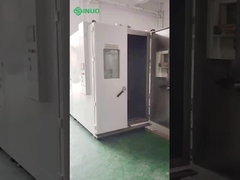
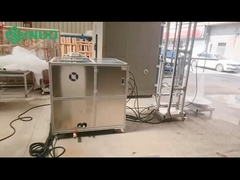
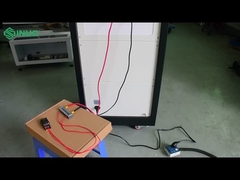
Brief: Watch this overview to discover why many professionals pay attention to this approach. In this video, you will see a detailed demonstration of the EV Charging Connector Bending Test Charging Interface Mechanical Endurance Tester in action. We showcase how it evaluates the mechanical reliability of EV charging connectors, industrial plugs, and sockets through precise bending cycles, driven by a high-precision servo motor. Learn how its user-friendly PLC control interface and adjustable parameters ensure accurate, standards-compliant testing for laboratories and manufacturers.
Related Product Features:
Tests bending performance of EV charging connectors and industrial plugs per IEC 62196-1 and IEC 60309-1 standards.
Features three test stations for simultaneous evaluation of multiple specimens.
Uses a high-precision servo motor for accurate and repeatable bending cycles.
Includes a PLC intelligent control system with a 7-inch touch interface for easy operation.
Allows adjustable bending angles from 0 to 360 degrees and preset cycles up to 999,999.
Supports various load weights (20N to 100N) and bending rates (0-60 times/min).
Equipped with mechanical clamping and alignment for minimal lateral displacement during tests.
Provides reliable performance with stable AC220V power and a durable, compact structure.
Las preguntas:
What standards does this bending test machine comply with?
The machine complies with IEC 62196-1:2014 clauses 7.11 and 7.15 for EV charging connectors, and IEC 60309-1:2012 clause 24.4 for industrial plugs and sockets, ensuring it meets international testing requirements.
How many test specimens can be evaluated at once?
This tester features three independent test stations, allowing simultaneous bending tests on up to three specimens, which increases efficiency for laboratories and manufacturers.
What is the range of bending angles and cycles that can be set?
The bending angle is adjustable from 0 to 360 degrees, with a default of ±45°, and the number of bending cycles can be preset from 0 to 999,999, offering flexibility for various endurance testing scenarios.